

Participating Defense Counsel

Charles P. Dunkel Jr.
Attorney

Ashley N. Thomson
Attorney
Flat-rate does not mean flat advocacy — our attorneys are trial-tested and prepared to litigate cases through dispositive motion practice and trial when required.
– Ashley Thomson
Flat Rate Panel Defense – Powered By Thomson Dunkel Law
An Old Idea – A New Concept

For decades, insurance carriers have understood a simple truth: the value of defense counsel is not measured by hours billed, but by outcomes achieved and costs controlled over time. Long before sophisticated billing analytics and audit vendors, litigation was managed through trust, experience, and predictable engagement structures. Over time, however, hourly billing became the default—not because it produced better results, but because it was easy to administer and universally accepted.
That acceptance has come at a cost. As liability litigation in Texas has grown more complex, hourly billing has introduced volatility into ALAE, extended case lifecycles, and created friction between carriers and counsel that has little to do with the merits of the defense. Adjusters and litigation managers are often forced to manage invoices instead of claims, and defense strategy becomes entangled with timekeeping rather than resolution.
FlatRate Panel Defense revisits the original premise—that defense counsel should be aligned with the carrier’s need for predictability, discipline, and efficient resolution—and applies it to the realities of modern litigation. By structuring defense work around a flat-rate, portfolio-based model, we remove incentives that reward delay and replace them with incentives that favor early evaluation, controlled litigation velocity, and consistent execution in Texas courts.
This is not a rejection of rigor or advocacy. It is a recognition that how defense work is priced shapes how defense work is performed. Our model reflects how carriers actually evaluate performance: stability of ALAE, time-to-closure, long-tail exposure, and defensible outcomes for insureds. In that sense, the concept is new—but the underlying idea is as old as claims handling itself.
Carrier Lines We Support Through Flat-Rate Defense
FlatRate Panel Defense is designed to support liability lines where defense economics, litigation mechanics, and claims oversight benefit most from a predictable, flat-rate structure. Our focus is on high-volume, moderate-severity matters where disciplined defense execution and cost stability materially improve portfolio performance.

General Liability (Bodily Injury & Property Damage)
We provide flat-rate defense for commercial General Liability matters arising from bodily injury and property damage claims. These cases form the core of our model, where early evaluation, controlled discovery, and proportionate motion practice drive both outcomes and cost predictability.

Construction Defect (Small to Mid-Market)
Defense of construction defect claims involving residential and commercial projects, excluding large-scale, multi-jurisdictional matters, or general contractors. These cases frequently involve long-tail exposure, multiple parties, and extended timelines—conditions where a defined flat-rate structure provides meaningful value to carriers.

Commercial Auto Liability
Defense of third-party bodily injury and property damage claims arising from commercial auto exposures. These matters share similar litigation dynamics with GL claims and are well-suited to portfolio-based defense pricing.

Products Liability (Single-Plaintiff Defense)
Defense of non-mass-tort products liability matters involving individual claimants. These cases are typically motion-driven and resolution-focused, making them compatible with a structured flat-rate model.

Premises Liability
Including retail, hospitality, multifamily, and commercial premises claims. These matters often present repetitive fact patterns and benefit from consistent defense handling, early liability triage, and efficient resolution strategies aligned with exposure.

Flat-Rate Defense: Practical Considerations
| Key Considerations | Our Approach |
| Flat-rate models encourage attorneys to do less work. | Flat-rate structures remove incentives tied to time accumulation, not effort. By eliminating timekeeping and billing disputes, attorneys reallocate time to substantive case evaluation, strategy, and resolution rather than documenting activity. |
| Defense counsel may cut corners without hourly oversight. | Carrier oversight does not disappear—it becomes more meaningful. Flat-rate defense replaces task-by-task approvals with structured reporting, early evaluation, and defined decision points aligned with exposure and litigation posture. |
| Complex cases may be under-resourced. | Most General Liability cases resolve within a finite window and predictable scope. When intensity increases—such as trial preparation or trial itself—defense effort converts to a separate, clearly defined structure that scales appropriately. |
| Hourly billing ensures diligence and accountability. | Hourly billing measures activity, not effectiveness. Flat-rate defense shifts accountability to execution, judgment, and outcomes—how carriers actually evaluate defense performance. |
| Flat-rate defense limits flexibility. | In practice, flat-rate defense increases flexibility by allowing counsel to act decisively within an agreed framework, without repeated approvals that slow litigation and increase administrative cost. |
| Administrative control is reduced. | Administrative overhead is reduced, not control. Flat-rate defense minimizes invoice review, billing audits, and approval friction while preserving visibility into case posture, exposure, and resolution strategy. |
| Defense costs could become unpredictable in long-tail cases. | Flat-rate defense structures account for long-tail exposure through defined case life terms and automatic reductions beyond expected resolution windows, limiting variance rather than increasing it. |
| This model is untested or novel. | Flat-rate defense reflects how most claims already resolve. What is new is not the concept of predictable defense spend, but the alignment of pricing with how claims departments measure success. |
How Our Flat-Rate Defense Model Works
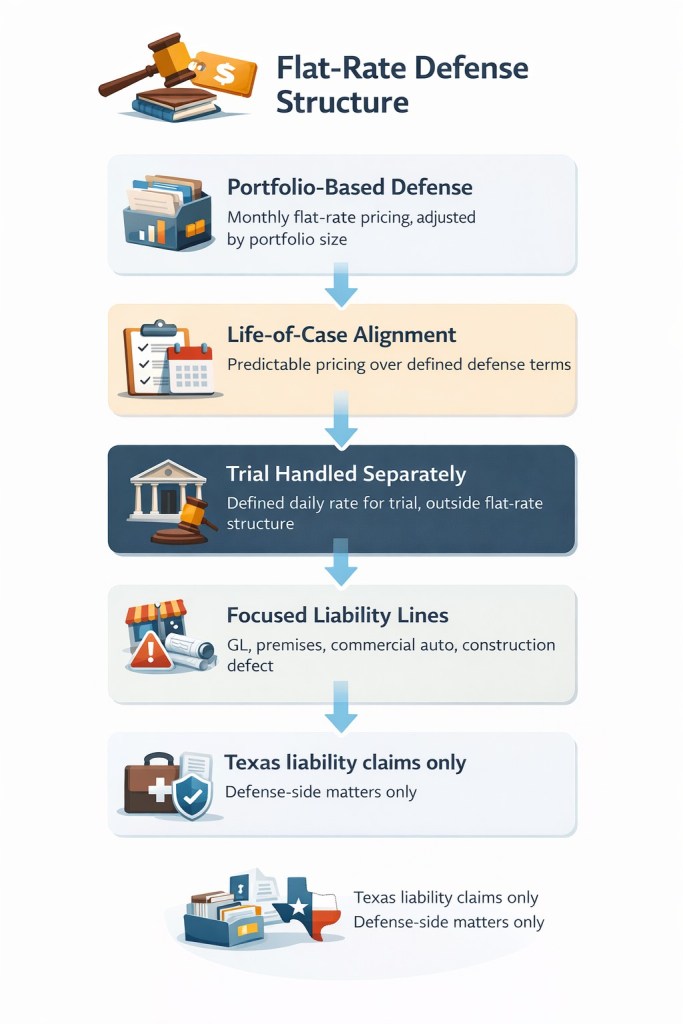
FlatRate Panel Defense provides a structured, flat-rate defense option for Texas liability litigation, designed to align with how carriers manage claims, forecast ALAE, and evaluate defense performance. The model replaces hourly billing with a predictable framework that emphasizes disciplined execution, early evaluation, and proportionate litigation.
Portfolio-Based Defense Structure
Defense services are provided on a per-case, per-month basis, with pricing determined by the number of active cases assigned to the firm. As portfolios scale, the structure adjusts accordingly, allowing carriers to maintain consistent defense economics across similar claims without renegotiating budgets or managing phase-based approvals.
Life-of-Case Alignment
Cases are handled under a defined life-of-case framework rather than segmented billing phases. Most matters resolve within an expected window; for cases that extend beyond that timeframe, the structure accounts for long-tail exposure in a predictable way rather than escalating unpredictably over time.
Trial Handled as a Distinct Event
Trial preparation and trial attendance are treated as separate events from routine defense activity. When a case proceeds to trial, pricing converts to a clearly defined daily structure, ensuring that increased litigation intensity is addressed transparently without distorting everyday defense costs.
Focused Scope, Clear Boundaries
The flat-rate model is intentionally scoped to liability lines where predictability and disciplined execution matter most, including General Liability, premises liability, commercial auto liability, and small-to-mid-market construction defect defense. Defense-side matters only. Texas-based litigation only.
Visibility Without Billing Friction
While the model eliminates hourly invoices, it does not eliminate oversight. Carriers receive consistent reporting on case posture, exposure, and resolution strategy, allowing claims teams to focus on outcomes rather than invoice administration.
**Detailed rate information and portfolio configurations are provided directly to carriers evaluating panel or pilot engagement. Defense services include attorney and paralegal work. Litigation costs (experts, transcripts, e-discovery, filing fees) are always the Carrier’s responsibility under the FlatRate Panel Defense Agreement.

Our approach is intentionally narrow. We concentrate on Texas-based liability claims where predictable defense economics and disciplined execution make the greatest difference. This focus allows us to deliver consistency across portfolios and clarity in how defense resources are deployed.
Flat-rate defense is not intended to replace every panel relationship. It is designed to complement existing structures by providing carriers with an additional option for managing high-volume, moderate-severity claims more efficiently.
For carriers evaluating whether this model fits their claims environment, we provide clear structure, defined boundaries, and transparent engagement terms—without unnecessary complexity. Detailed rate information is shared directly with insurance professionals assessing panel or pilot participation.
If you are exploring alternative defense models for Texas liability claims, we invite you to review our structure and determine whether FlatRate Panel Defense is an appropriate fit for your portfolio.
 FlatRate Panel Defense | Texas Liability Defense